Powering a Greener Future

There were a number of positives to take from 2022 in the global fight against climate change: the US enacted an unprecedented climate bill; an agreement was reached at COP27 to aid poorer countries impacted by global warming; and investment in renewables and clean technologies soared.[1]
However, the overall picture remains critical.
To limit global warming to 1.5°C above pre-industrial levels, the world needs to cut current greenhouse gas emissions by 45% before the end of the decade.[2] We also need to invest more than $1.3 trillion a year in our decarbonization efforts by 2030 to limit the global rise in temperatures to targets set out in the Paris Accord, according to the International Energy Agency (IEA). That’s three times more than we currently spend.[3]
Most of that investment -- and innovation -- must come from the private sector, which has a critical role to play, according to Michael Bloomberg. “More and more business leaders recognize that economic growth and climate action are not two competing ideas -- they go hand in hand,” he told attendees at the launch of a report aimed at mobilizing private climate finance.[4]
This resonates deeply with Japan’s Panasonic, which has a deep-rooted commitment to reducing emissions, transitioning to clean energy, and driving greater circularity across its businesses.
“Efforts to fight against climate change and decarbonize can be compatible with economic growth,” said Yuki Fukushima, Chief, Environment Management Department, Panasonic Operational Excellence. “The role of a company is to innovate by providing high-quality products and services – and also contribute to society. We believe a positive, symbiotic relationship can exist between the economy and the environment when companies actively create business opportunities through their decarbonization efforts.”
From Panasonic’s perspective, this means helping us to make positive changes -- or ACTs -- in our daily lives that help us to live more sustainably. It says the accumulation of these “ACTs” will eventually have a greater "IMPACT" on the fight against global warming.
With this in mind, the Japanese multinational, which specializes in cutting-edge technology across a wide range of sectors including consumer electronics, aviation, automotive, and industrial systems, launched Panasonic GREEN IMPACT (PGI),[5] its long-term vision to reduce greenhouse gas emissions across its factories to virtually zero by FY2031, and impact avoided emissions throughout society by 2050.
“Solving global environmental issues is our top priority, and achieving net zero by FY2031 is only the beginning,” Tatsuo Ogawa, Group Chief Technology Officer of Panasonic Holdings Corporation, told the audience at CES 2023 earlier this year.
“Our goal is to lower CO2 emissions for the entire planet by 1% of current total global emissions by 2050. That’s more than 300 million tons of CO2 saved from our atmosphere. It’s an ambitious goal – but an achievable one.”
To get there, the PGI initiative targets three areas: “OWN IMPACT,” which means reducing emissions across its entire value chain; “CONTRIBUTION IMPACT,” which refers to reducing emissions across society through its existing businesses and technologies; and “FUTURE IMPACT,” which is about minimizing emissions through the development of brand-new technologies.
According to Panasonic, it emits around 2.2 million tons of CO2 per year through its factory operations.[6]
This has led it to invest in zero-carbon factories across the globe. Each facility will implement energy-saving measures such as LED lighting, generate electricity in-house via renewable sources such as solar, switch all procured electricity to 100% renewable energy sources, and offset remaining fossil-fuel derived emissions with credits according to the characteristics of that particular plant.
Panasonic has gone a step further by introducing the world’s first[7] trial of a manufacturing plant capable of being powered entirely by renewable energy.[8] The demonstration facility at Kusatsu, in Japan’s Shiga Prefecture, is equipped with multiple energy sources -- solar panels; hydrogen fuel cells; and lithium-ion batteries -- with output optimized to ensure a stable supply independent of weather conditions. The plant’s energy management system will eventually be able to predict solar power generation patterns based on weather forecast data. Using this information, the system will determine the amount of electricity that needs to be provided via each source.
Panasonic is also focused on how it makes its products -- used by an estimated one billion customers each day globally[9] -- in a drive to contribute to a more circular economy. It has implemented what it refers to as “recycling-oriented manufacturing,” which means materials contained within end-of-life products are recovered and reused in future manufacturing rather than sent to landfill. For instance, Panasonic Eco Technology Center in Japan’s Hyogo Prefecture can recover valuable resources such as plastic, iron, copper, and aluminium at a high degree of purity from televisions, air conditioners, washing machines, and refrigerators.
The second area of focus is the decarbonization of society generally. For Panasonic, this means replacing carbon-intensive technologies with cleaner and more efficient solutions.
One of the most important areas is the fast-growing market for electric vehicles, which saw global sales jump from 3.2 million in 2020 to more than 10 million in 2022, according to BloombergNEF[10] --. Panasonic is playing a critical role in enabling this growth with the development and mass production of lithium-ion batteries for EVs. Its focus has been on consistently improving battery performance while limiting the quantity of rare metals it uses. On one hand, Panasonic has progressively reduced the amount of cobalt in battery cathodes to less than 5% through the use of alternative materials.[11] While strategic partnerships -- such as its collaboration with American battery recycling specialist Redwood Materials[12] -- are advancing sustainability in the supply chain, which will allow it to reuse copper and other materials.
Panasonic is also investing in mobility, with a host of eco-friendly innovations showcased at CES this year,[13] from a new light-weight, low-energy consumption audio entertainment system for electric vehicles, to an eBike designed for greater accuracy and efficiency on paved roads as well as rougher terrain.
Source: H2 KIBOU FIELD Demonstration Facility Utilizing Pure Hydrogen Fuel Cell Generators.
Another area of innovation is hydrogen fuel cell technology, which can power and heat commercial buildings using energy generated through a chemical reaction between high-purity hydrogen and oxygen in the air. The only by-product is water, so it’s completely clean. Panasonic, which has been developing this technology for more than two decades, launched its pure hydrogen fuel cell generators in 2021 with the aim of pushing hydrogen as a 24-hour option to augment solar power across factories and other facilities in future.[14]
By adopting these new technologies, CO2 emissions can be reduced or eliminated altogether -- an important area that Panasonic refers to as avoided emissions. Panasonic believes avoided emissions are a key pillar of sustainability but are not being recognized currently.
“Panasonic supports efforts to promote avoided emissions and standardize their measurement,” Panasonic’s Ogawa said at CES in January.
“Last year, we joined the World Business Council for Sustainable Development, which recently announced guidance on avoided emissions,[15] along with 200 of the world’s leading sustainable businesses, to work towards a net-zero future,” he said. “We also support the International Electrotechnical Commission, which is working to standardize global definitions and calculation methods for avoided emissions.”
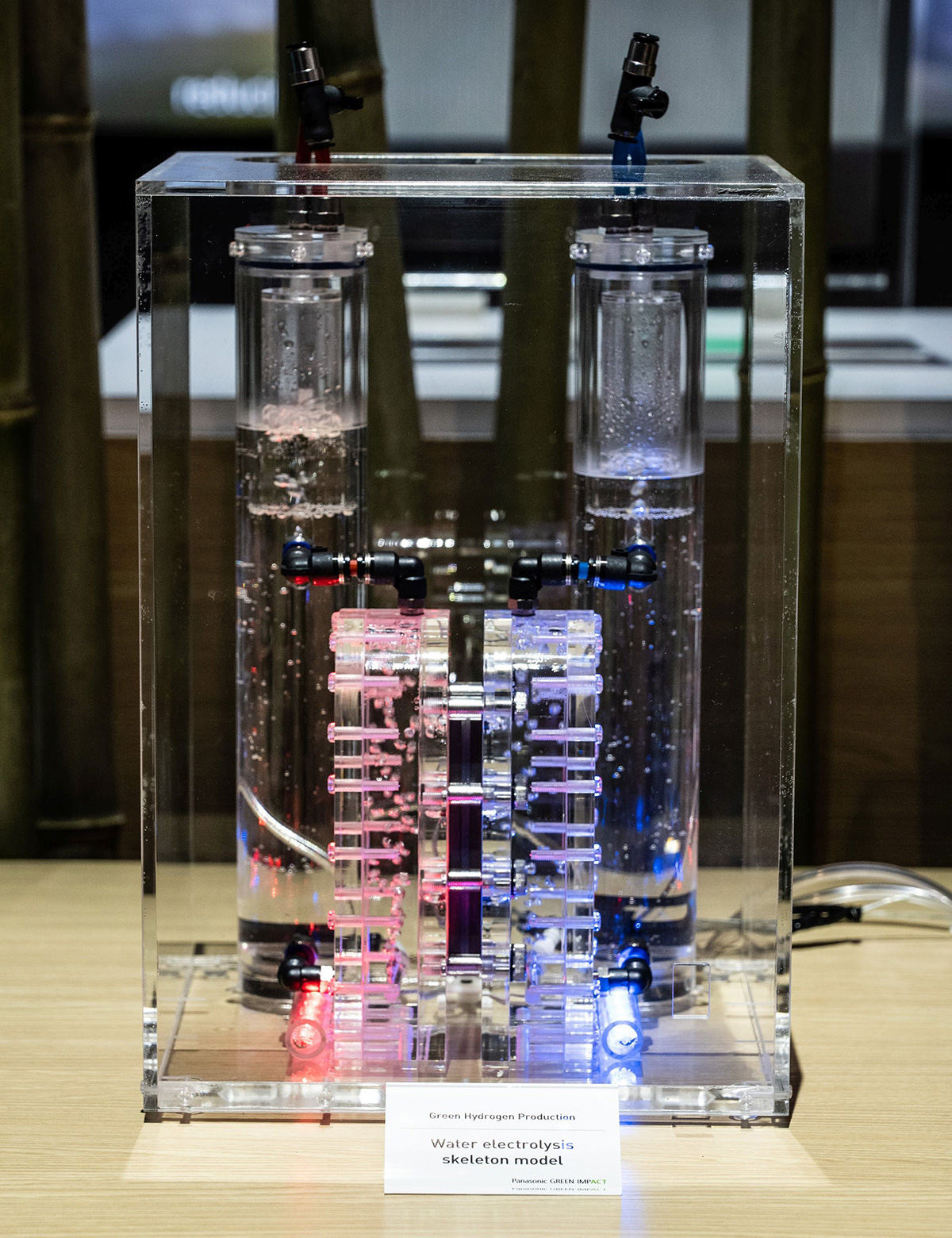
And the third area of focus for the PGI initiative is about how Panasonic can help society to avoid future emissions through cutting-edge technologies still in development.
For instance, it is working on a green hydrogen production device, which it showcased at CES 2023.[16] The device uses electrolysis powered by renewable energy to reduce the cost of generating CO2-free hydrogen -- also known as green hydrogen. The device also features catalyst materials that are highly active and free from precious metals such as platinum and iridium, which reduces costs and boosts efficiency. In turn, the device could accelerate the adoption of green hydrogen. Panasonic plans to provide test samples of its green hydrogen production device within three years.
The Panasonic GREEN IMPACT initiative demonstrates how effective and influential the private sector can be when it comes to our collective decarbonization efforts. By choosing to take responsibility for carbon emissions beyond its own direct operations, Panasonic has continued its legacy of being a business for good. It is driving technological solutions that are ultimately cleaner, more efficient, and cost-effective. And this will ultimately give us a fighting chance of achieving our ambitious climate goals.
“We must continue to focus on carbon neutrality as a company,” said Fukushima from Panasonic Operational Excellence. “Our businesses cover a wide range of sectors vital for the transition to clean energy. We believe this is an opportunity for Panasonic to drive global efforts to become carbon neutral.”
Sources:
[1] IEA [2] UNEP [3] Bloomberg [4] Bloomberg [5] Panasonic GREEN IMPACT [6] Panasonic [7] According to research by Panasonic, as of March 31, 2022; the first-ever demonstration of hydrogen being used exclusively as fuel for in-house generation of the electricity required for operation of an individual factory. [8] Panasonic [9] Panasonic [10] BloombergNEF [11] Panasonic [12] Panasonic [13] Panasonic CES 2023 [14] Panasonic [15] World Business Council for Sustainable Development (WBCSD) [16] Panasonic