Key Insights
We believe that retirement outcomes can be modestly increasing equity allocations at the front and back ends of the T. Rowe Price glide paths.
Our research suggests that modestly higher equity levels potentially can improve consumption replacement without materially raising balance variability near retirement.
We are not changing equity allocations in the years immediately before and at retirement, when investors appear to be most sensitive to market volatility.
Addressing Today’s Retirement Challenges
The daunting reality today is that many investors face powerful headwinds to achieving a comfortable retirement. As the retirement landscape shifts away from defined benefit pensions, future retirees will need to rely ever more on other income sources, such as their individual retirement accounts (IRAs) or defined contribution (DC) plans. However, it is widely understood that many investors are chronically underfunded—they simply aren’t saving enough to meet their expected retirement needs.
Life expectancies also have risen over the past 20 years, meaning today’s retirement investors are likely to need income streams that last longer than their currently anticipated time horizons.
- 1 Averaged across both men and women. CDC, National Vital Statistics Reports, Vol. 69, No. 12, November 2020. On the Web at: https://www.cdc.gov/nchs/data/....
- 2 CDC, National Vital Statistics Reports, November 2020.
- According to the Centers for Disease Control and Prevention (CDC), the conditional average life expectancy of U.S. individuals age 65 increased by two years between 2000 and 2018, from 82.5 years to 84.5 years. 1
- CDC data also indicate that there is a relatively high probability of individuals living into their 90s, meaning they’ll need to support consumption for multiple decades. 2
To help investors face these formidable challenges, T. Rowe Price is enhancing its glide path strategies for target date investment funds. Target date investments are made up of other underlying funds that are purposefully-selected, globally-diverse building blocks designed to provide a mix of different investments that adjusts over time, often referred to as the glide path, up to and throughout retirement.
While a glide path strategy for a target date fund typically becomes more conservative as an investor retirement, our new insights give us confidence that most target date participants are less sensitive to market volatility than may be commonly believed.
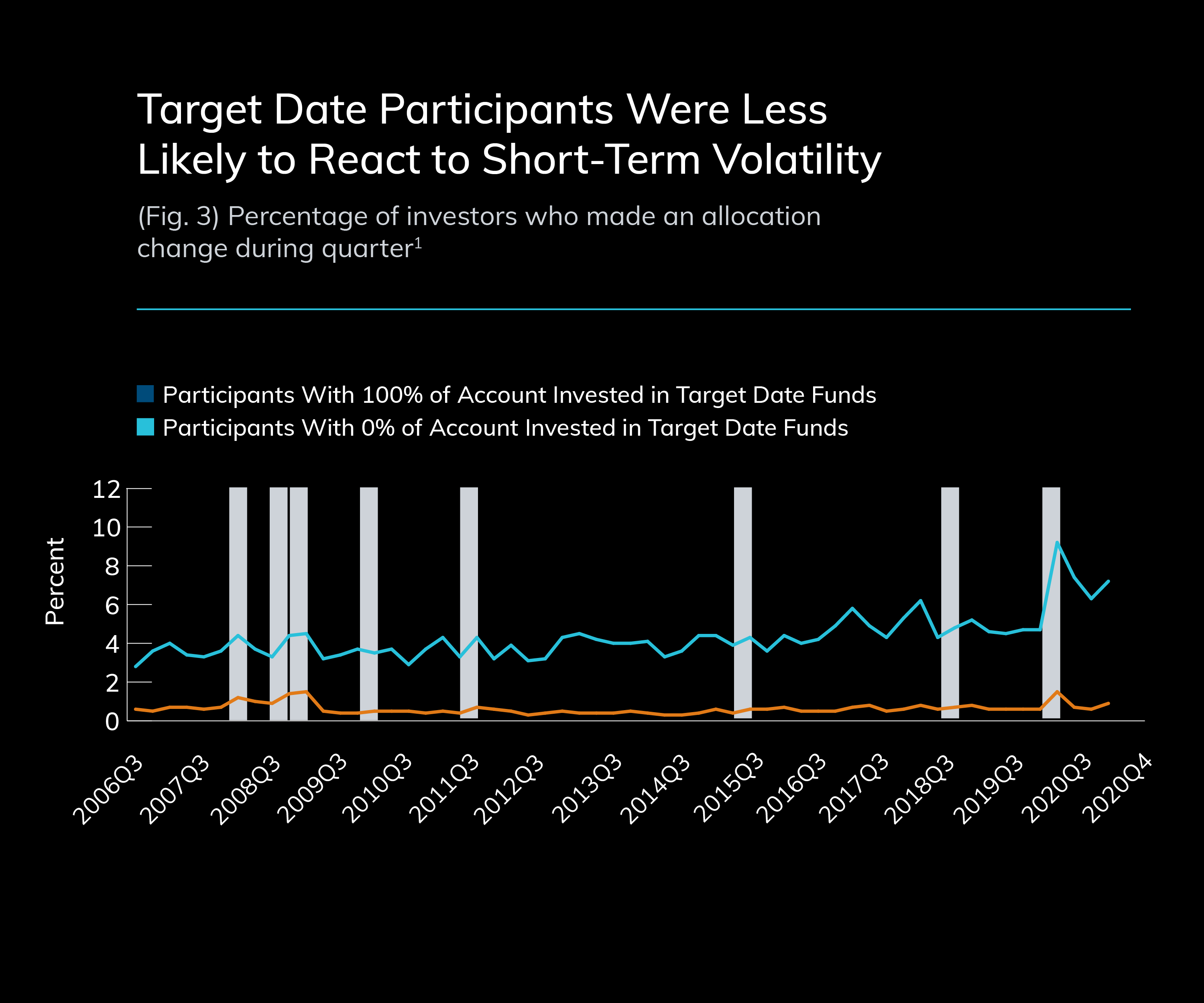
- 1 Third quarter 2006 through fourth quarter 2020. Source: T. Rowe Price. Shading represents quarters in which the S&P 500 Index dropped by more than 5%. Based on quarterly data for all DC plan participants in retirement plans administered by T. Rowe Price.
As a recent example, 2020 saw a significant amount of market volatility, both upside and downside, related to the coronavirus and its economic impacts. Equity markets went through a swift and short bear market, followed by a speedy rebound and then a rally at the end of the year. Importantly, our data show that the vast majority of target date investors stayed the course with their investment through this volatile period and thus we're likely to end the year with higher account balances than when they began.
Indeed, the target date investors in our data were eight times more likely to keep their investment allocations intact compared with non-target date investors. In our view, this comparison confirms that target date investors are using these investments appropriately for the long haul.
To us, the data suggest that modestly higher exposure to market volatility is an acceptable trade‑off for participants as they seek to achieve better long‑term outcomes in retirement.
The demographic and behavioral trends described above have only reinforced our view that achieving adequate portfolio growth is critical for most retirement investors. We also believe that the potential benefits of a growth‑oriented strategy are likely to outweigh the potential negative impacts of large market declines close to or soon after retirement.
Historically, the compounding of the equity risk premium—the additional return on stocks relative to bonds—has led to meaningful differences in investment outcomes. Although equities have been more volatile than bond and other fixed income assets over shorter periods, the higher long‑term returns associated with equities typically have facilitated wealth accumulation over the long term.
Enhancements in Equities
The T. Rowe Price approach to target date investing has long reflected our view that retirement investors need adequate exposure to growth‑oriented assets. Trends in target date investing—and our continued focus on improving our methodology since we launched our first target date strategies in 2002— have only strengthened this belief.
Accordingly, T. Rowe Price is moving to increase equity exposure modestly at the front and back ends of our glide paths,3 while leaving equity allocations unchanged in the years immediately before and at retirement. These changes began in April 2020, are being phased in over a two‑year period, and currently are expected to be completed in the second quarter of 2022, depending on market conditions.
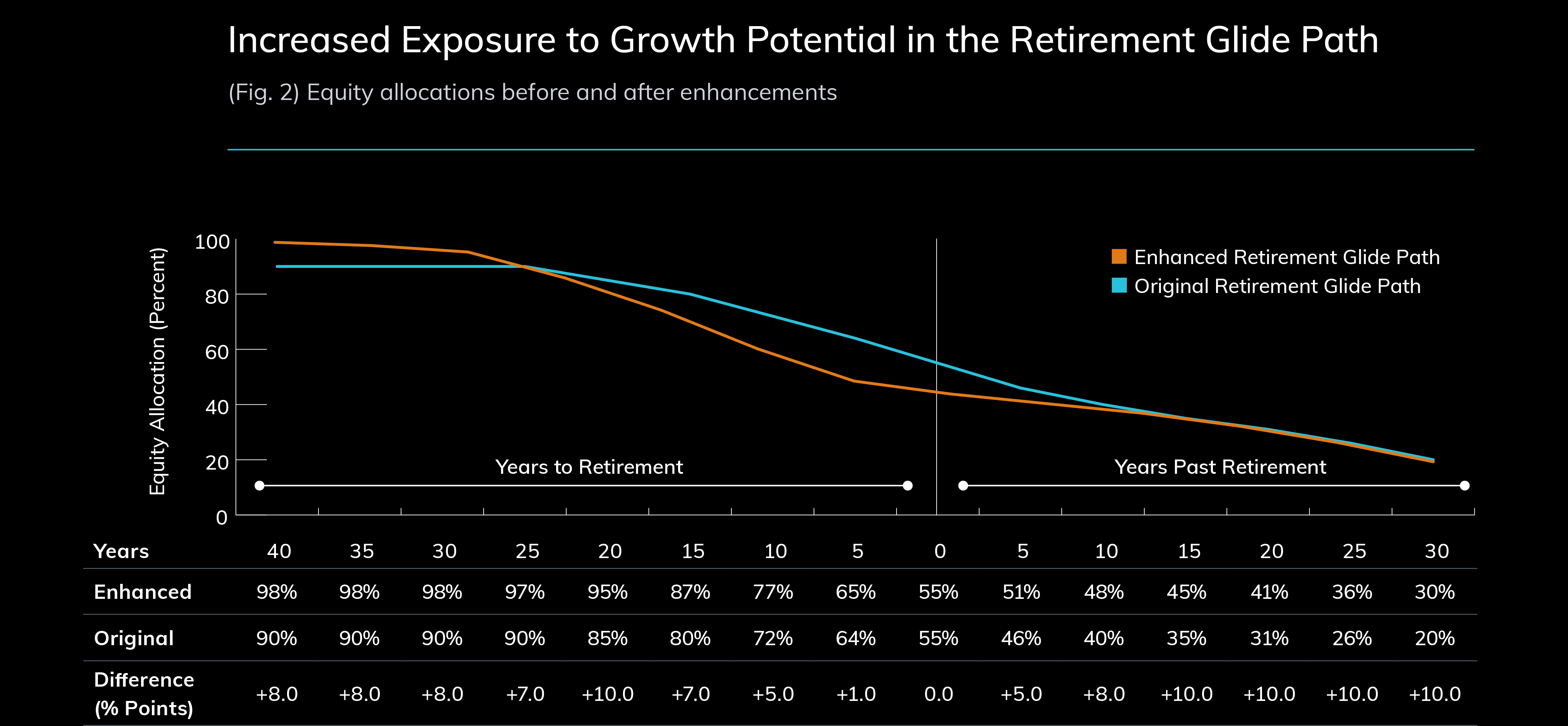
The changes to the Retirement Glide Path will raise the equity allocation at the beginning of the glide path to 98% from the current 90%, will hold the allocation at 98% equity until 30 years from retirement (rather than the current 25 years), and will raise the equity allocation at the back end of the glide path to 30% from the current 20%. The equity allocation at retirement will remain at the current 55% (Figure 2).
- 3 Glide paths act as a guide for a target date fund’s bond and equity allocations, determining how the strategic allocations in a target date fund will change over time. The glide path will adjust to become more conservative over time.
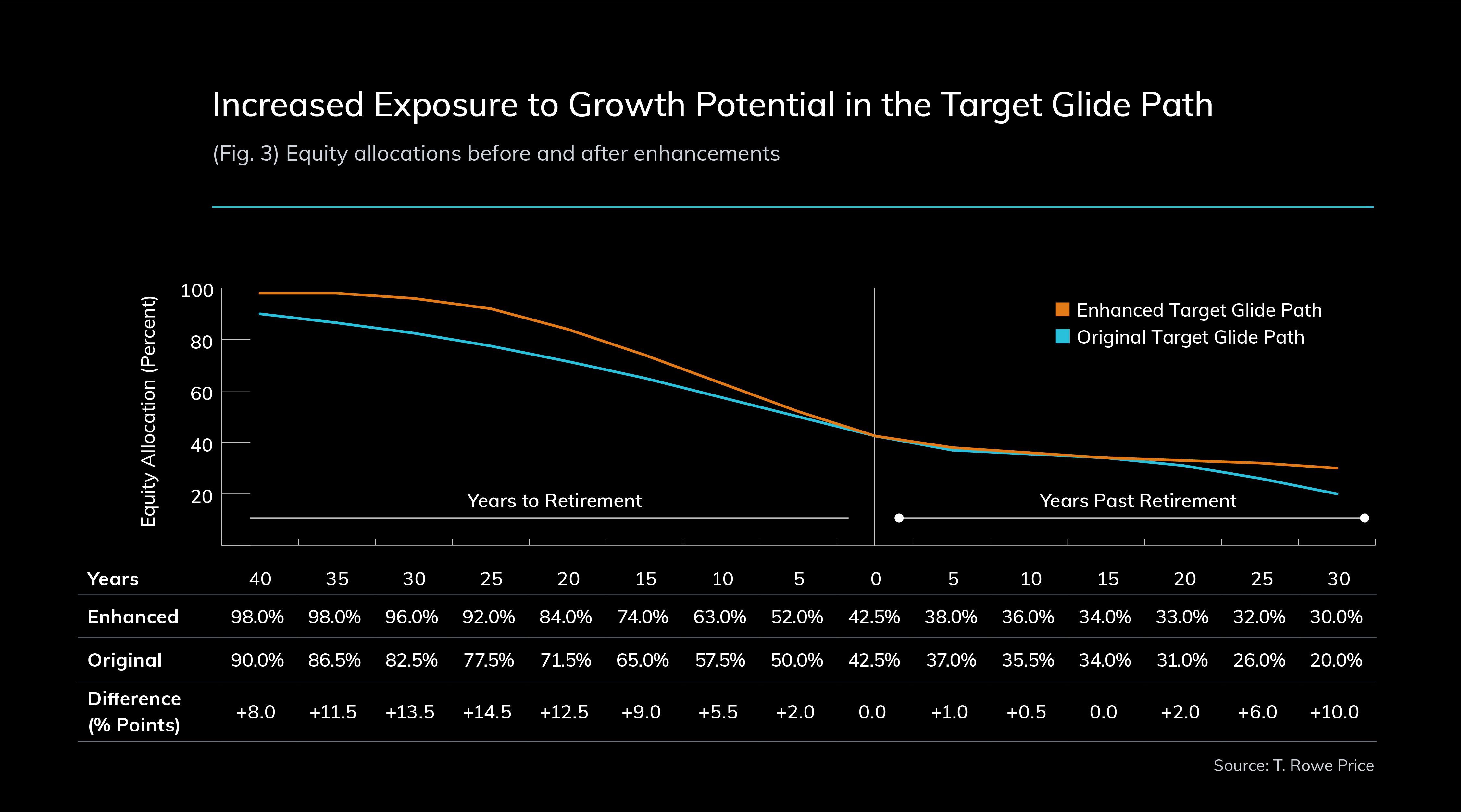
The initial equity allocation in the Target Glide Path will be raised to 98% from the current 90% and will remain at 98% until 35 years from retirement rather than immediately starting to roll down as it does currently. The equity allocation at the back end will rise to 30% from the current 20%. The equity allocation at retirement will remain at its current 42.5% (Figure 3).
We have been implementing these enhancements gradually to limit the equity increases across our portfolios. Equity levels in portfolios that are currently close to their target dates—and so most susceptible to market risk—will not be increased. These include the 2020, 2025, and 2030 vintages of the balance variability around retirement, which is when investors typically are most sensitive to such fluctuations. However, there is no assurance that the results of these analyses will be repeated or that they indicate future outcomes of the enhanced glide paths.
4 The objective of funding a given standard of living during retirement, conventionally defined as the replacement of preretirement income net of preretirement savings.
T. Rowe Price’s Glide Path Approach
The first step in our design process is to define the glide path objective. This is informed by the relative focus that retirement investors place on trade‑offs between key goals, such as sustaining consumption versus avoiding portfolio volatility, or funding income needs over a lengthy retirement versus achieving a defined level of wealth at the time of retirement.
T. Rowe Price currently offers two different glide paths in portfolios because we recognize that different investors may have different objectives. The primary objective of the Retirement Glide Path is to help support lifetime income for investors over a lengthy retirement. The primary objective of the Target Glide Path is to seek to limit balance variability around retirement, with a secondary focus on supporting income during retirement.
“We believe an effective approach to life-cycle investing must rely upon a deep understanding of both markets and investors."
Although the two glide paths take slightly different approaches, both are built with the view that an adequate retirement strategy must have some focus on income replacement. Enhancements we have made to our glide path design in recent years have made it possible for us to analyze investor demographics and behavior in more granular detail, which, in turn, has allowed us to better capture the diversity of characteristics and preferences among retirement investors.
We believe an effective approach to life‑cycle investing must rely upon a deep understanding of both markets and investors, reflecting how those elements potentially can evolve and interact over time. The first step is to understand the primary factors that can influence glide path design:
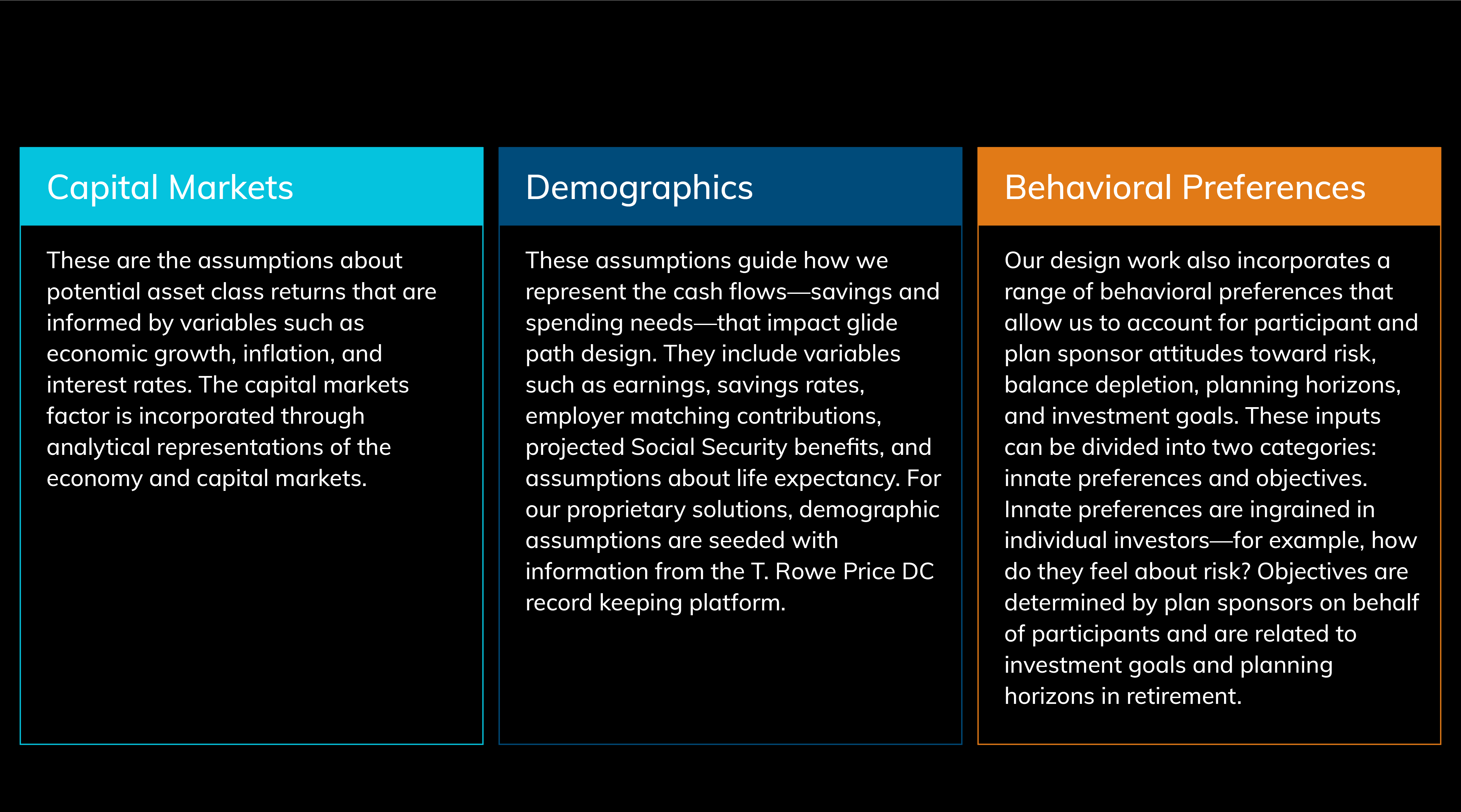
As discussed previously, defining the objective is the first step in our process. Once the objective is set, we calibrate the behavioral preferences, investment goal, and planning horizon to reflect the objective we are addressing. The economic and behavioral components of our process allow us to analyze thousands of different potential outcomes. We then seek to identify the glide path that robustly maximizes potential utility satisfaction5 as defined by the behavioral preferences, the plan sponsor objective, and the demographic inputs.
The final step of our process incorporates the judgment of our target date team. While our process is effective at applying the themes and insights of the team consistently across a population of investors, our depth and experience as an investment manager and record keeper provide critical balance as we seek to ensure that our analysis captures the potential benefits of our insights in the manner intended and in a way that reflects the needs of our clients. We believe this feedback loop is essential to building and maintaining a robust glide path construction process.
- 5 The level of satisfaction that individuals derive from a particular good or service—in this case, an asset allocation glide path. Our glide path design process seeks to construct the glide path that appears to have the highest utility potential as defined by a specific set of investor preferences and constraints.
More Robust Glide Path Inputs
The latest refinements in our design framework have made it possible for us to analyze demographic factors and behavioral preferences in more granular detail across participant populations, which, in turn, allows us to better capture the heterogeneity of characteristics and preferences within a given investor population. We have made multiple improvements to our framework, and these improvements collectively have led us to pursue enhancements to our glide paths.
1. Use of Probability Distributions Instead of Discrete Point Estimates
Our perception is that many target date providers currently use simple averages to represent key participant characteristics and behavioral preferences in their glide path methodologies. These averages may be derived from a broad universe of DC plan participants or, in customized glide paths, from the participant population of a specific plan.
Our research suggests that using probability distributions of key characteristics within a participant population, instead of simple averages, potentially does a better job of capturing participant heterogeneity, resulting in a more realistic analysis. We believe this approach can better reflect real‑world uncertainty, where the exact preferences of DC plan sponsors may be difficult or impossible to define for each input.
2. Assuming a Planning Horizon
We now assume everyone lives to a certain age (the median life expectancy) and then apply standard mortality probability after that. Previously, we had assumed some percentage of the population die before median life expectancy.
We believe our previous assumption was appropriate from an actuarial standpoint (i.e., the estimation of risks and potential costs typically associated with insurance policies), where individual risks are pooled. However, we are not addressing an actuarial problem. We are seeking to reflect an individual’s planning horizon. This change reflects our perception that participants tend to be more comfortable planning and making sure their expenses are covered up to a certain minimum age.
3. Wealth Depletion Aversion as an Innate Preference
Wealth depletion aversion is an innate preference in the sense that it is ingrained for a chosen individual, is not easy to change, and is not an objective that can be set. Depletion aversion captures an individual’s willingness to trade consumption to maintain their level of wealth.
Without a depletion aversion, investors could consume all their wealth over their lifetimes. Intuitively, we are attempting to capture how much an individual prefers having a positive balance, irrespective of future consumption. The parameter is designed to capture the observed inclination of current retirees toward a preference for avoiding wealth depletion.
4. Impact of Nondiscretionary Spending in Retirement
We recognize that spending needs in retirement depend on an individual’s salary. Lower‑salaried individuals tend to have larger amounts of consumption tied to nondiscretionary items and thus may have less flexibility to reduce spending in retirement. Therefore, they will need to replace a larger percentage of their preretirement income in order to maintain their standard of living in retirement.
5. Enhanced Capital Markets Analysis
Widening the distribution of possible outcomes has allowed us to analyze a wider variety of economic and financial environments, even relatively unlikely ones. We believe this provides an important stress test for our designs.
In our view, the enhancements we have made to our glide path process better capture the complexity of the problem we are seeking to address and create a design framework that better represents reality.
We believe that a more realistic approach reduces the sensitivity of results to the assumptions for each input; limits more extreme results and, in general, gives us greater confidence in our outputs.
Specifically, it provides even stronger reasons for us to believe that DC plan sponsors and participants have the ability to accept additional short‑term market risk at certain points along a glide path in order to seek better retirement outcomes.
Conclusions
T. Rowe Price has long believed that retirement investors need adequate exposure to equities and other growth‑seeking assets as they seek to support their anticipated income needs over what could be a lengthy retirement. Recent demographic and behavioral trends—as well as multiple improvements in our design framework— have given us greater confidence that modestly increasing equity exposure at certain points in the investment life cycle potentially can improve post retirement consumption replacement without materially affecting balance variability around retirement.
Reflecting these findings, we are raising equity allocations at the front and back ends of our Retirement Glide Path and our Target Glide Path, while leaving equity exposure unchanged in the years immediately before and after retirement.
Over the long term, we believe the enhancements could be beneficial for most retirement investors. Younger investors will have multiple decades to benefit from potential compounding of the equity risk premium and to recover from episodes of market volatility. For investors already in retirement, the modest nature of the changes in absolute terms may help mitigate the impact of short‑term market downturns.