
CFOs Look to the Cloud for Resilience (and Profit)
In the span of a decade, CFOs have gone from being the scorekeepers to playing on the field – helping the team craft its offensive capabilities when the rules of the game are constantly changing. With this shift, CFOs are now looking downfield to drive strategy. Results from Accenture’s CFO Now survey showed that 40% of CFOs drive new business models and revise strategy holistically.
That’s a promising start, and more change is coming.
CFOs prioritize data management
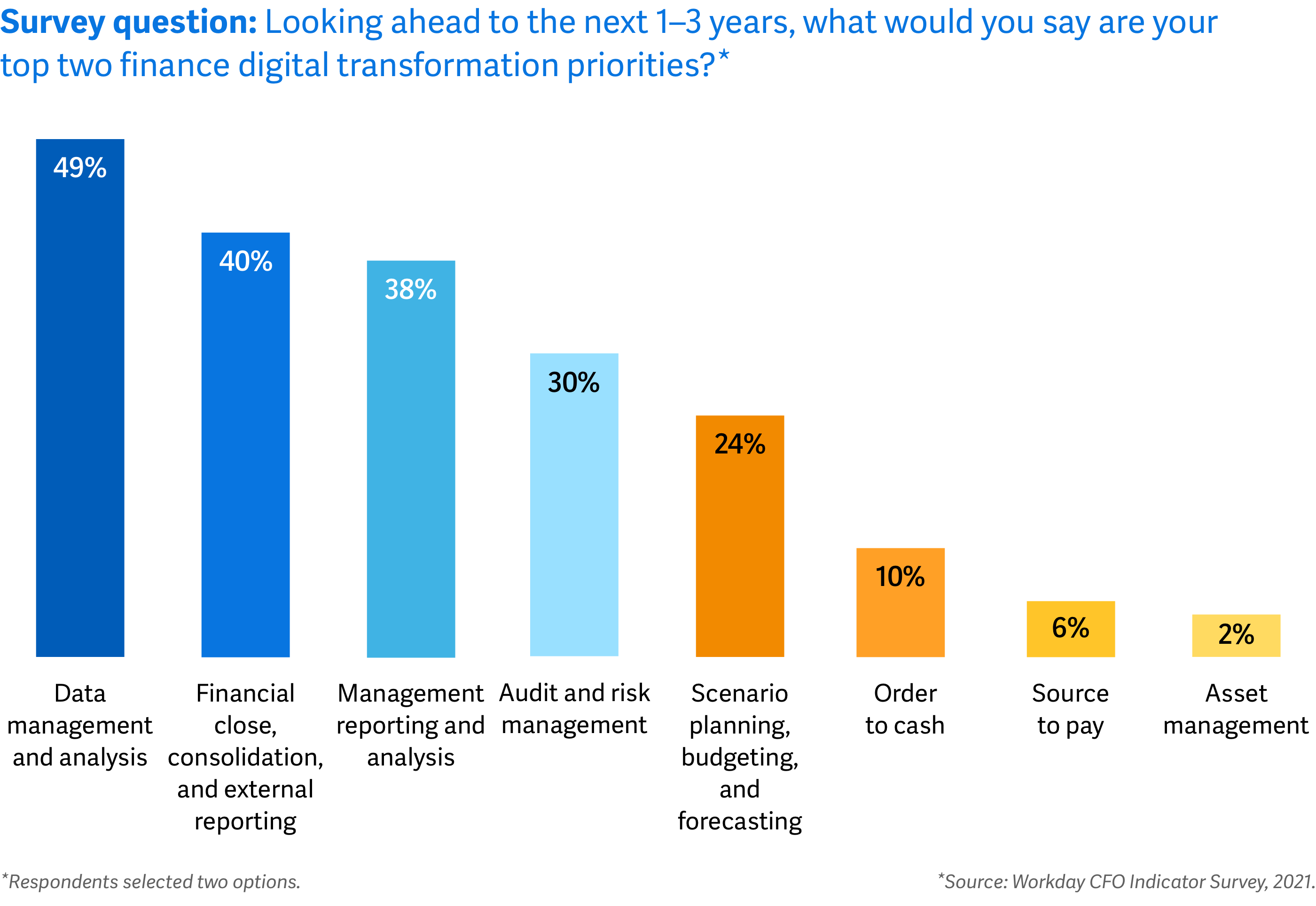
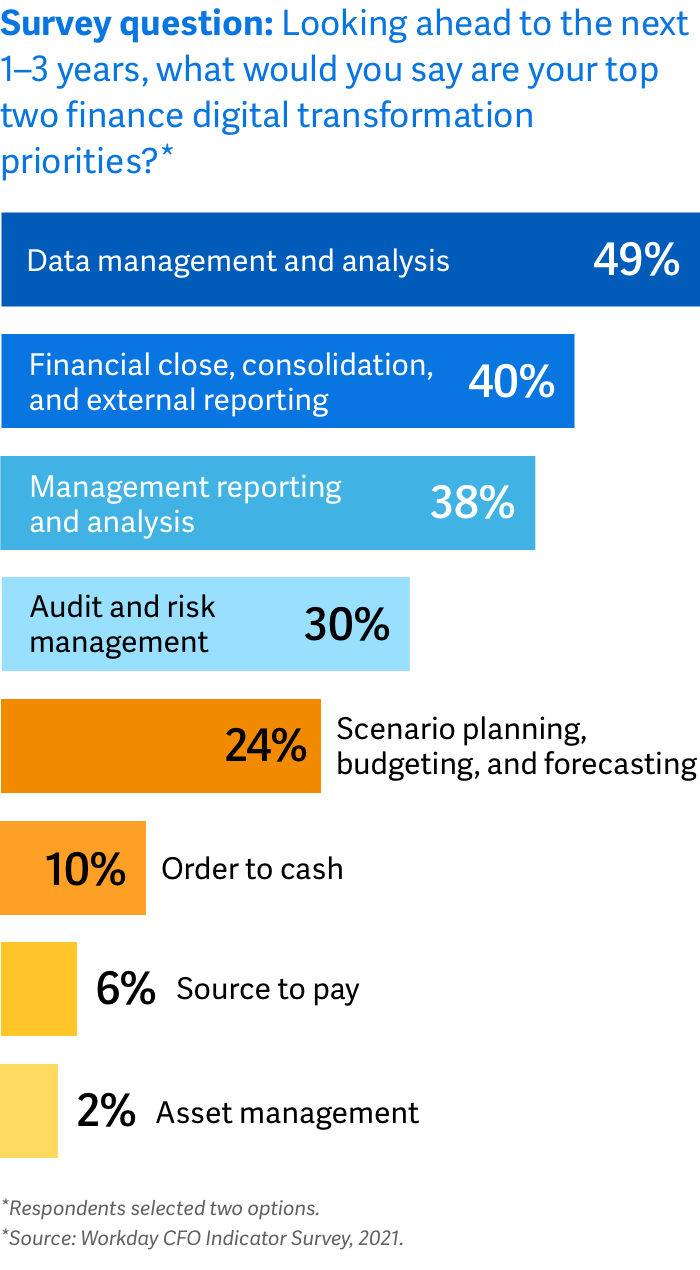
Most CFOs (72%) believe that their company will need to completely rethink processes and build more resilience into their operating models. They must use technology to relentlessly attack the inefficiencies of manual processes, while shifting resources to the long game of sustainability and adaptability. They must also prioritize data management and analysis.
About half of CFOs say those are indeed the top two priorities, while nearly two-thirds say they are reimagining their finance operations by investing in cloud-based solutions and deploying artificial intelligence and machine learning solutions to help automate and streamline routine operations. The use of technology coupled with a strategic operating model roadmap can create a finance function built for change, forming the foundation of an organization that is decision-ready and ready to withstand whatever disruption lies ahead.
The Pandemic Accelerated the Need for Transformation
The proliferating volume of data is transforming businesses. There is more data than ever, posing unique challenges for CFOs. Finance teams need to draw on information from all parts of the business – including operational, HR, sales and marketing, and external data – to make decisions quickly.
The pandemic highlighted the need for companies to stay nimble amid unpredictable market conditions. For example, Workday customers saw a 30x spike in scenario planning in early 2020, which didn’t decline as the year wore on. In fact, monthly scenario planning levels increased by 28% YOY in 2021.
“Boards are demanding digital acceleration,” says Karen dela Torre, Executive Director, Office of the CFO at Workday. “One of our customers, a top American hospital, had a three-year plan to transition to digitally-enabled telehealth. Because of the pandemic, they moved all their primary and ambulatory care to telehealth in 3 weeks.”
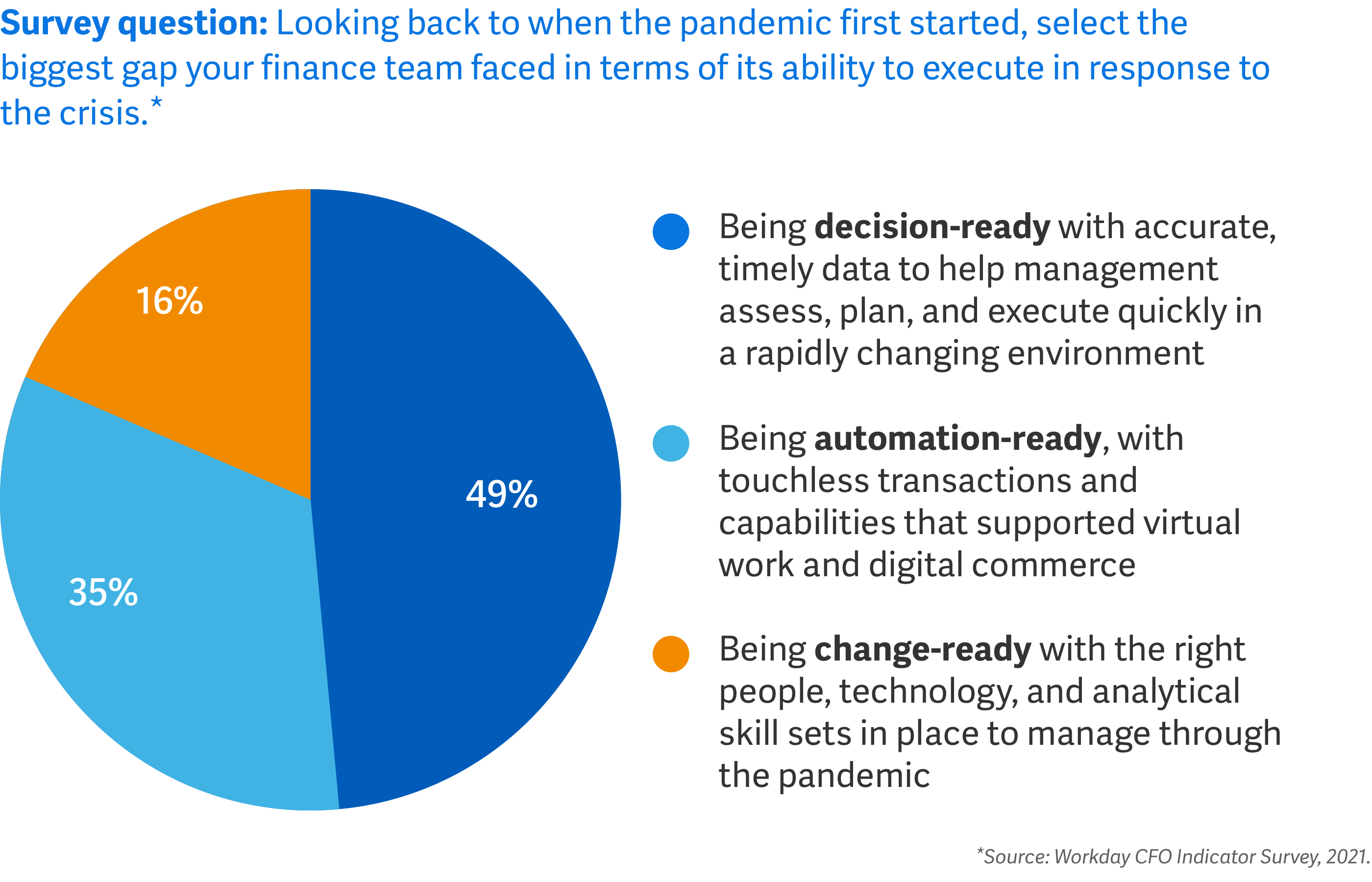
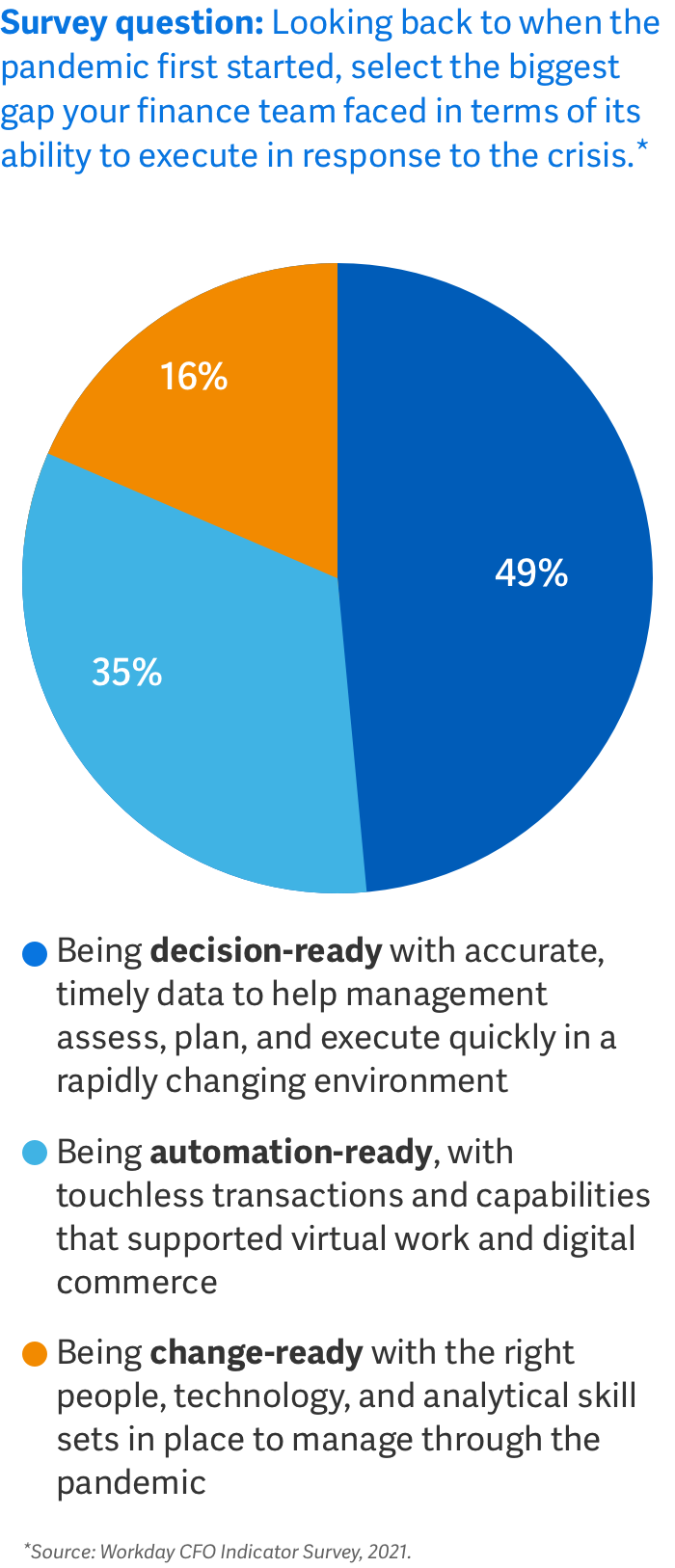
The biggest challenges during the initial onset of the global pandemic
Changing Data Ownership
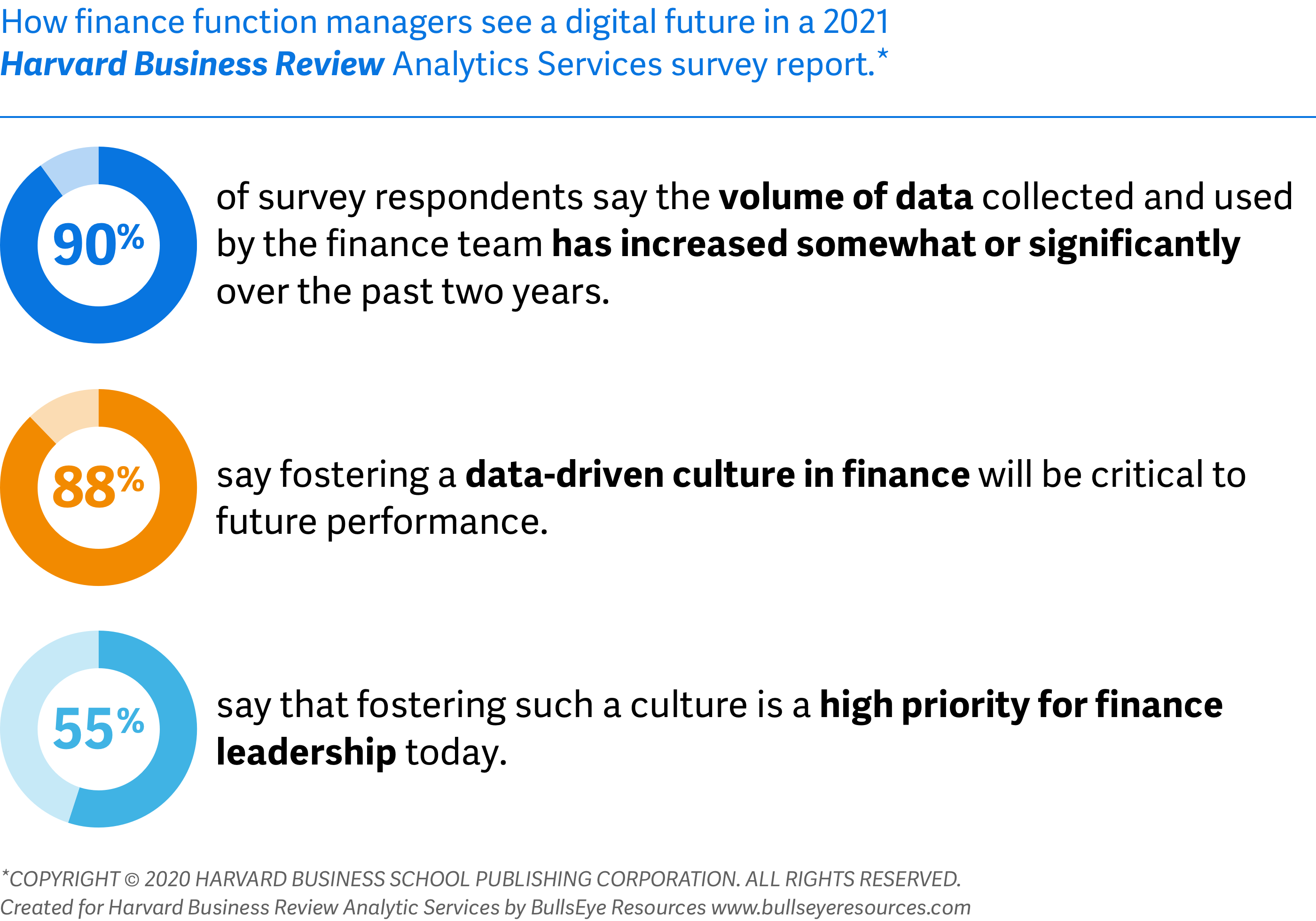
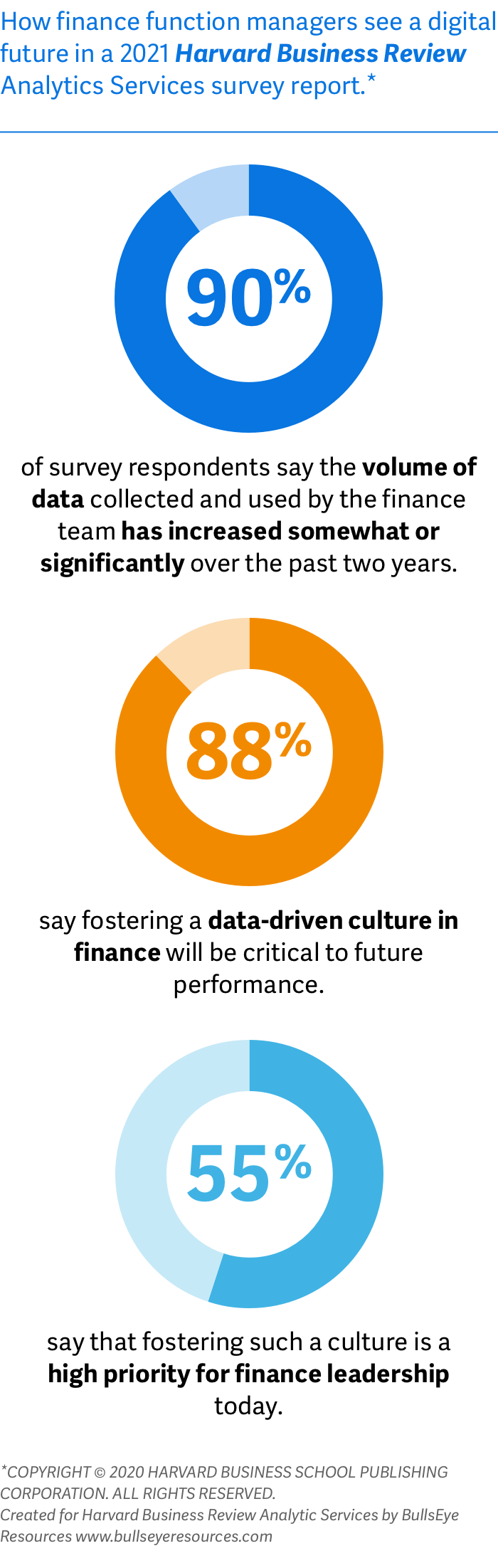
Most respondents to a survey conducted by the Harvard Business Review say that fostering a data-driven culture is important, but just over half are working on creating one. A centralized finance hub that democratizes data access empowers stakeholders across an organization to identify trends and make informed decisions backed by data.
“It’s important for finance professionals to understand the why behind the data,” explains Siobhan Delaney, VP of Finance Operations, Revenue and Internal Controls, Workday. “To do that, they need to understand the story behind the data, and its source.”
Delaney shares an example of a Workday Financials media customer that leverages Nielsen, HR data and finance data to spot hit TV programs and on-air talent in local markets that can then be leveraged in other markets, or even nationally.
Finance embraces the data-driven enterprise
The Role of the CFO Has Expanded
For finance to become a true value-creation partner, it needs to be able to rapidly analyze all the data needed to make informed decisions in real time. “We’ve moved from reliance on technology to partnering with it to solve the bigger, more complex business challenges,” says Delaney.
Take pricing, which is traditionally determined by marketing. A finance team can become a value-creation partner by analyzing data to determine the optimum price point that increases profit margins. With this in mind, Workday delivers dashboards that can provide insights into the profitability of each product or service in a company’s portfolio.
Finance teams can use real-time data to model and predict future attrition rates with Workday as well. “Our People Analytics team matches employee data with weekly employee sentiment surveys to predict future attrition rates,” Delaney explains. “We use these predictive analytics to do financial forecasting.”
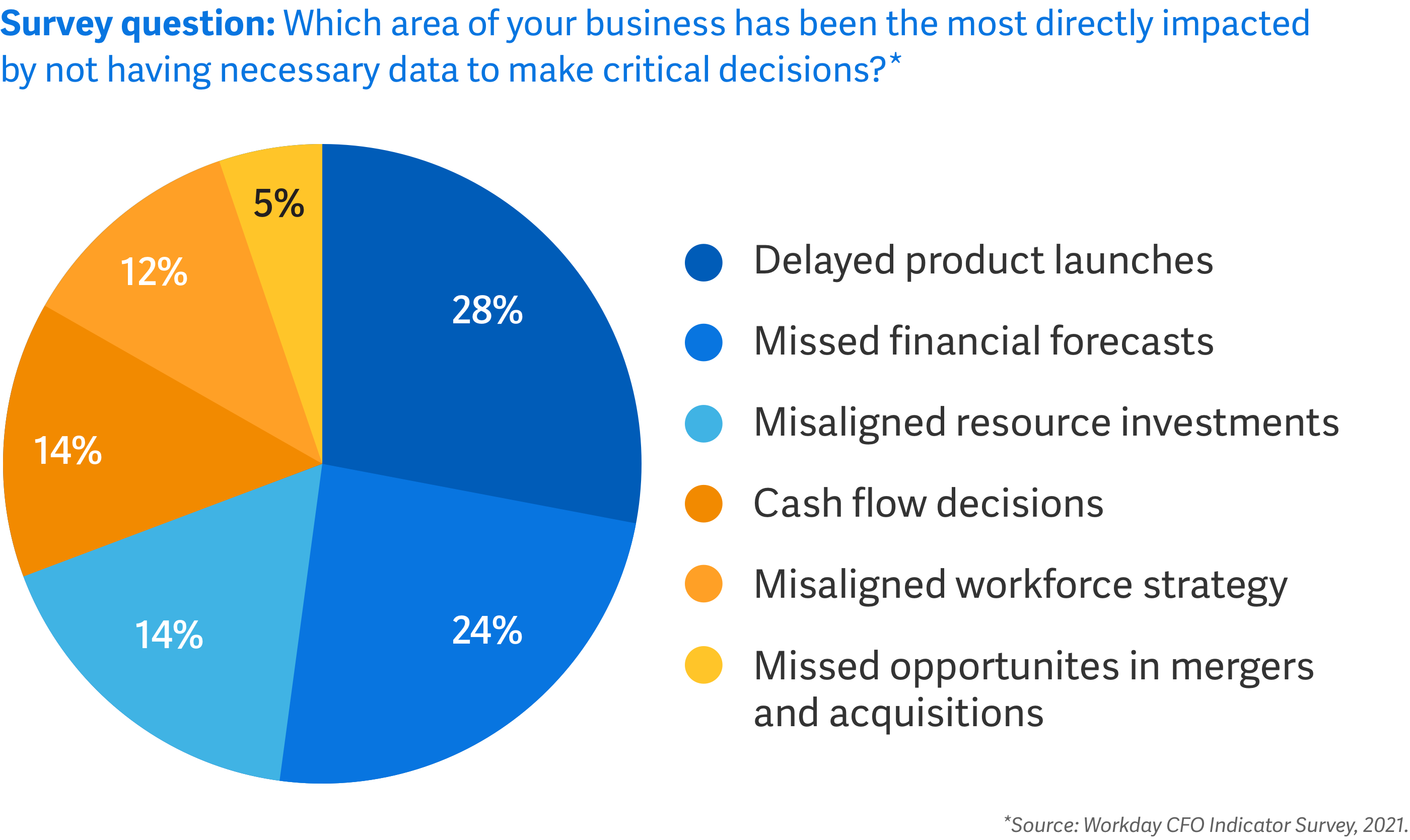
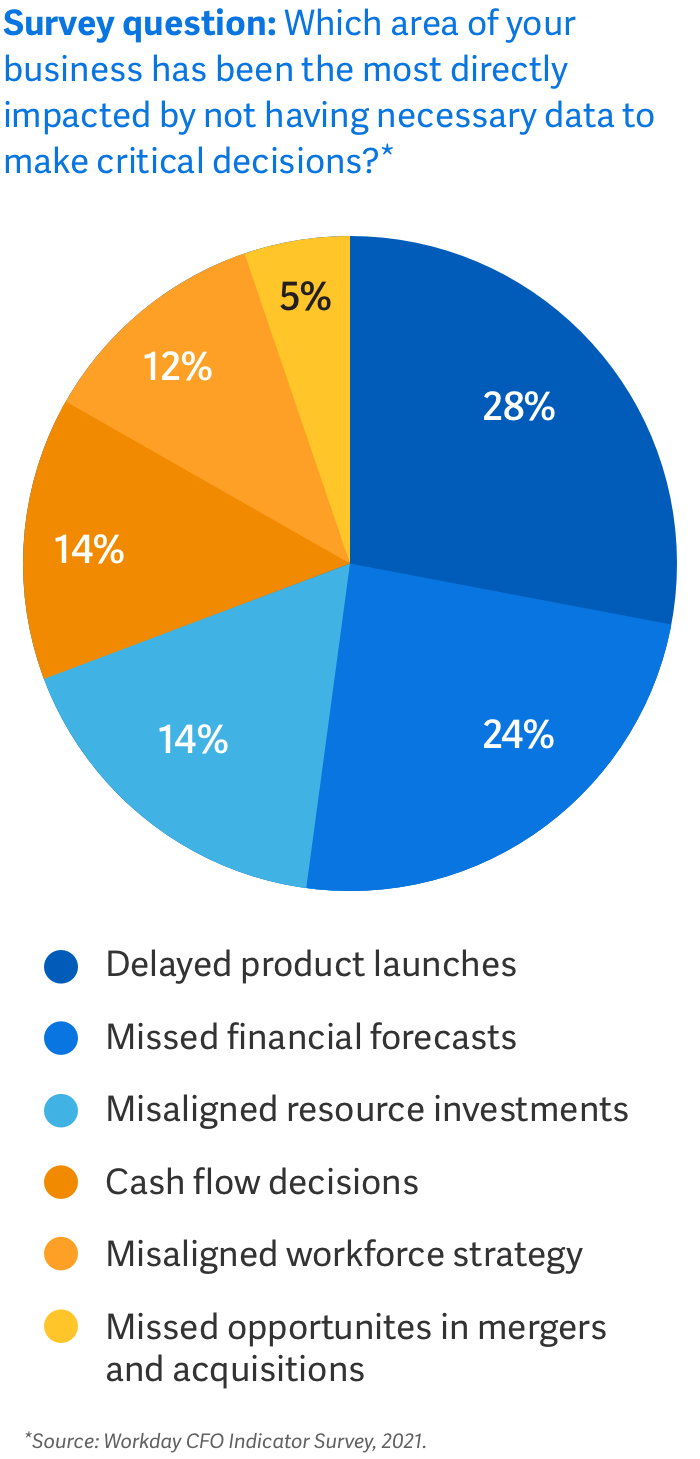
Missing data impacts critical business outcomes
The Road to Intelligent Finance Process Automation
Workday utilized its own solutions for the Office of Finance to drive friction out of many processes, achieving 100% automation of its cash flow and customer billing, and almost 100% of manual journal entries. With this success, Workday believes it can ultimately remove friction from the close process in the form of a zero-day close. “We’re only beginning to scratch the surface on what we can do to automate processes,” says Delaney.
Many respondents (77%) to a recent Harvard Business Review survey still rely on labor-intensive manual processes to collect and utilize data. Artificial intelligence is on the horizon, but with little progress thus far. Only 15% of respondents said they are very confident that their organization would deploy AI, ML, or predictive analysis to augment their processes in the next three years.
When automated, processes that would otherwise take days can be finished in hours. Over the past three years, Workday customers experienced a 70% average improvement in accounting capabilities, a 72% improvement in audit capabilities, and a 47% improvement in FP&A capabilities, with FP&A time spent on strategic work increasing over 80%.
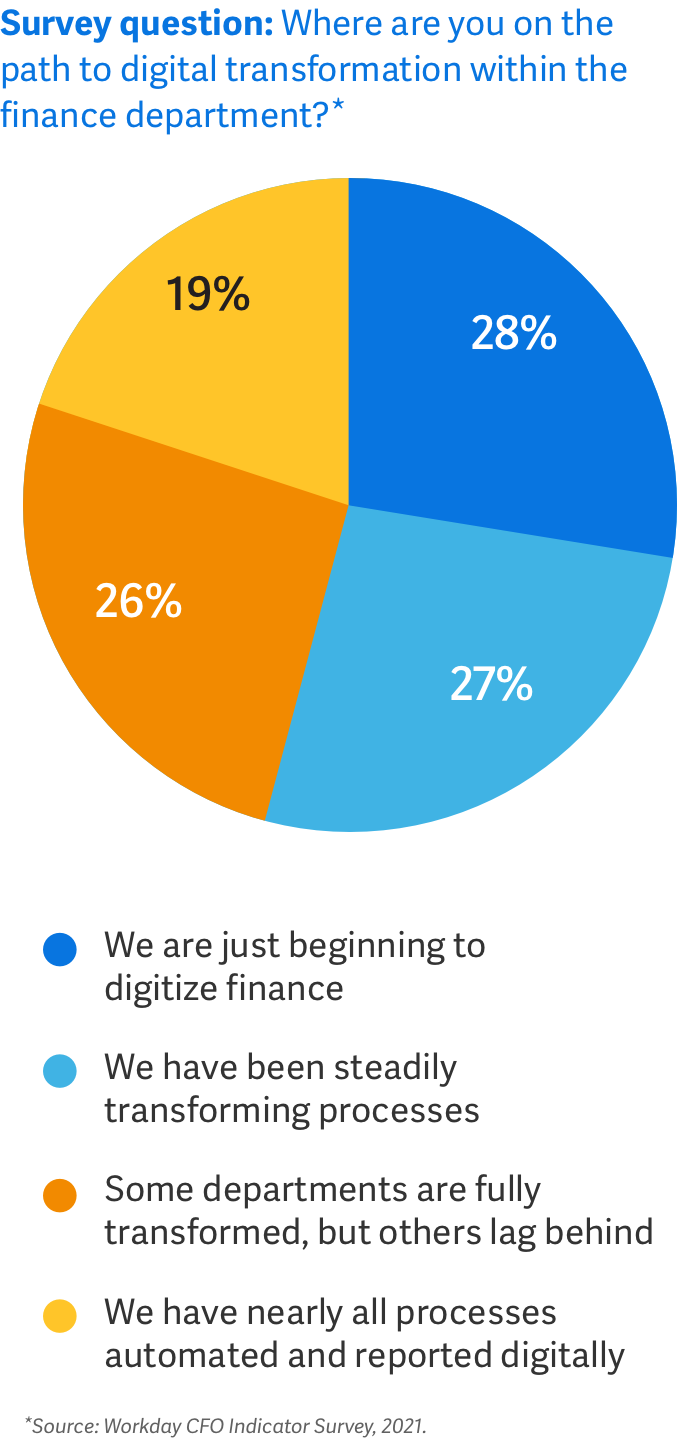
Every enterprise is at a different stage in their digital transformation journey

Become Decision-Ready With Good Data Governance
Organizations with traditional ERP accounting systems currently spend a lot of resources on data cleansing and reconciliation. Moreover, “cleansed” data generally doesn’t have the attributes needed for finance professionals to do their analysis without additional manual manipulation. Streamlining data access with Workday enables the heads of FP&A to get information in real time and make informed decisions faster. It also allows for more automation, eliminating time-consuming and error-prone manual processes.
When one U.S. media enterprise saw advertising revenues decline, it conducted scenario planning using Workday’s Adaptive Planning and reduced the time spent on monthly reporting, forecasting and budget updates from two days to 30 seconds. Another example: Alight, a global professional services firm, standardized data on Workday’s cloud-based platform. Doing so reduced time to close from nine days to three, while time spent gathering billing data was reduced by 60%.
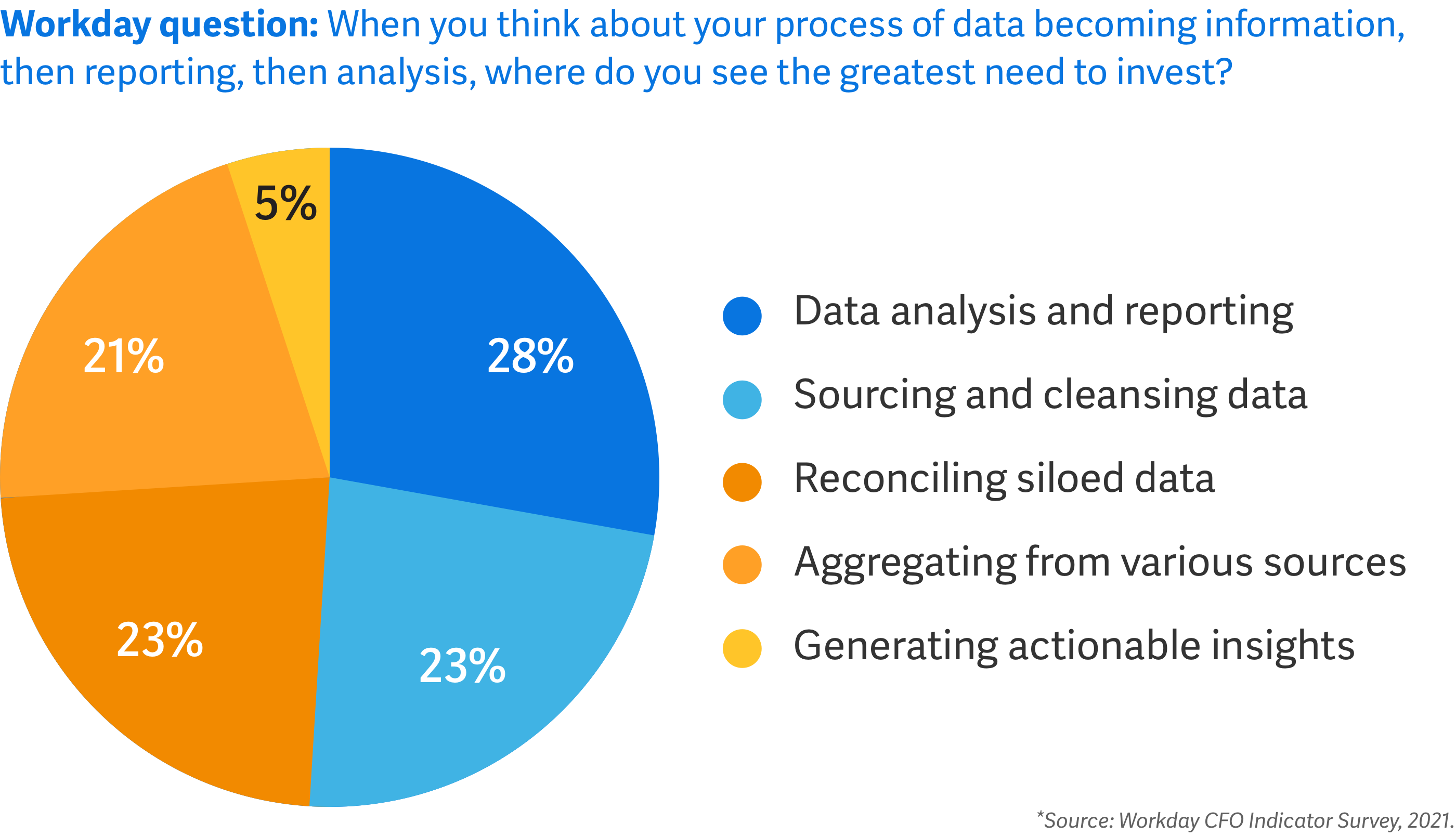
CFOs are focusing on data to drive business insight
Single Data Hubs: Your Operational Advantage
Organizations that break down data silos can unite disparate data groups, helping finance teams uncover new efficiencies. For example, a nuclear power plant used Workday’s benchmarking capabilities to compare operating metrics against competitors and among its own reactors. An analysis of the data uncovered several issues with helium use that resulted in a half-million dollars in operational cost savings.
Another Workday customer, a fast-growing online food order and delivery service based in Europe that recently acquired a U.S.-based company, is using Workday as a data hub and enabler of M&A strategy because it easily folds in external data sets with the company’s financial and people data. With Workday, the company can look at profitability down to an individual delivery driver. This unprecedented level of granular insight is made possible by Workday’s ability to unify point-of-sale data with financial and people information in one system.
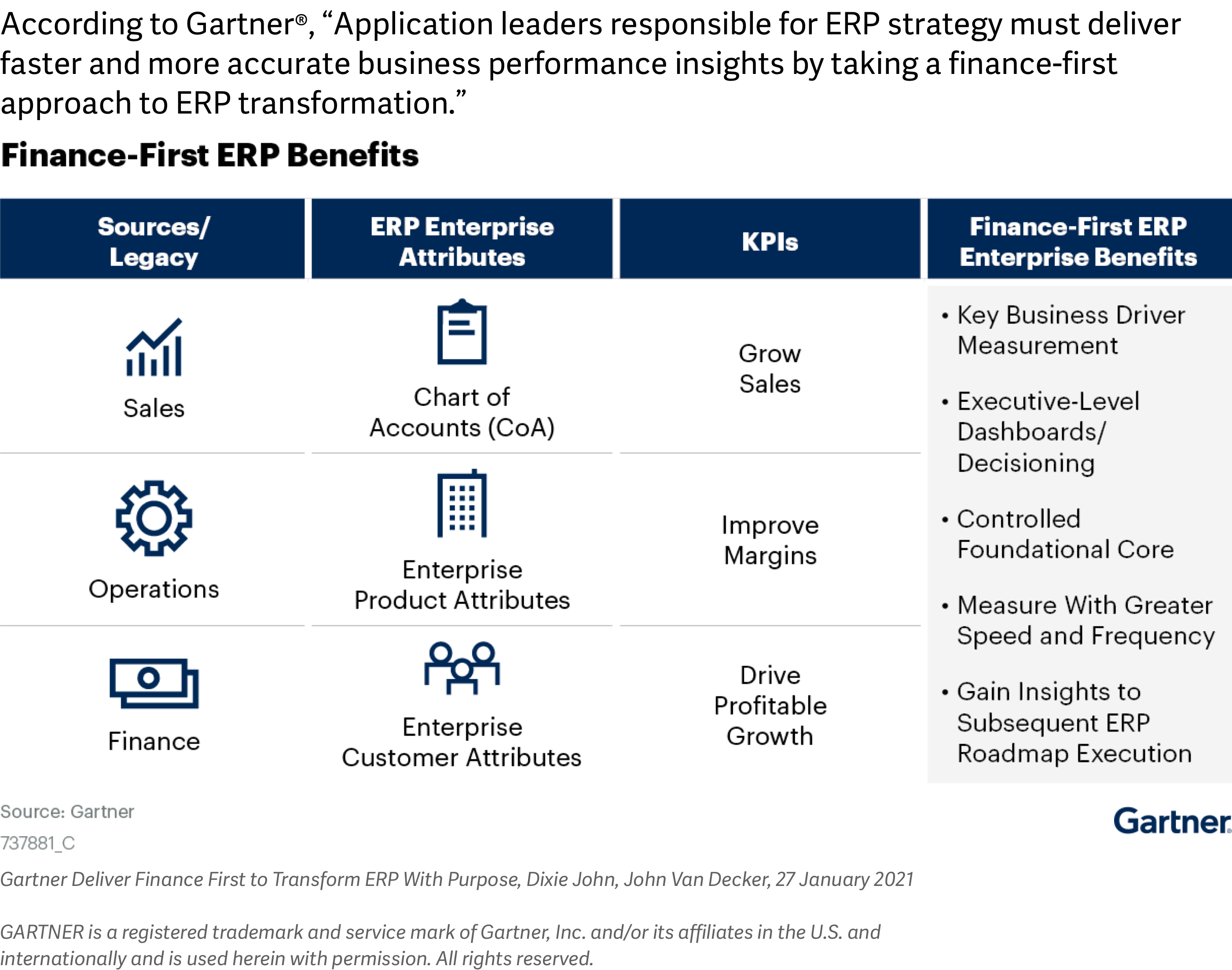
The digital journey starts with the finance function
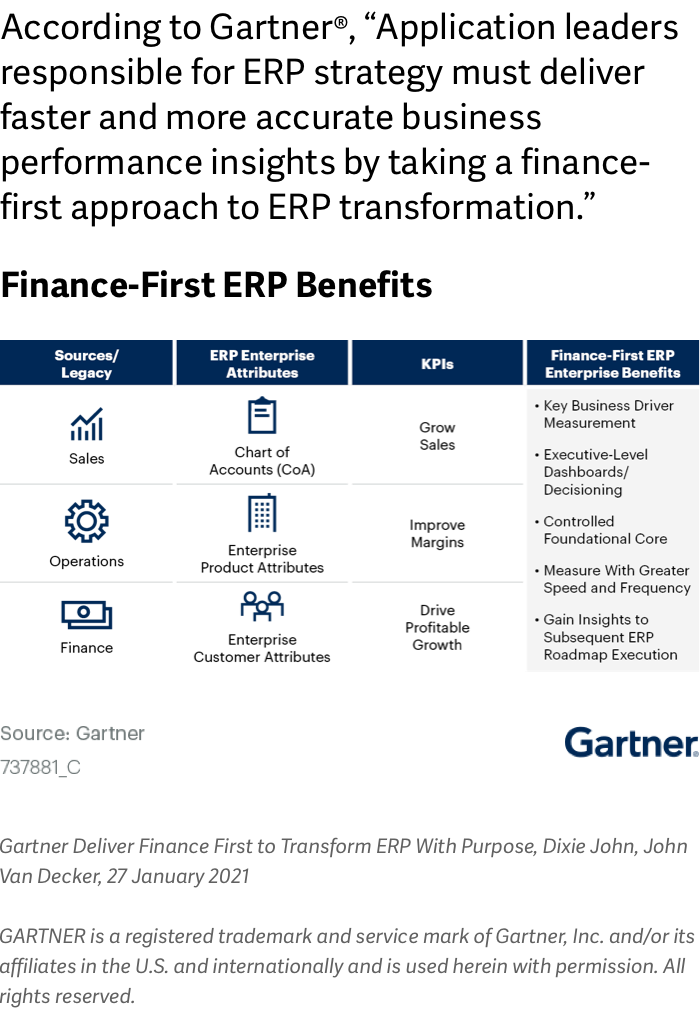
Attracting and Retaining Talent
Amid all the concern about the “Great Resignation,” 43% of CFO respondents in a recent survey said that their priority technology investment to address workforce concerns is an integrated finance and HR system. Companies that have unified these systems are better equipped to reorganize, plan and model compensation scenarios and track plans for increased retention.
“The best companies are saying, ‘If you want a change, look within the company first,” says Karen dela Torre. “One of our customers – a large global professional services firms with over 600,000 employees – calls it the ‘Great Reorganization.’”
With Workday, finance and HR can easily find new roles, reorganize groups and departments and model workforce scenarios and compensation. They can even model the skills they’re going to need, including financial and workforce plans, and then track actual performance against those plans.
“If you don’t have a single finance and HR system, you have to do a lot of reconciliation. Ultimately, what both finance and HR leaders want is more time to do value-added analysis. They don’t want to be bogged down processing transactions or reconciling data inconsistencies. Getting to the good stuff means being able to drive improved decision-making.”

Karen dela Torre, Executive Director, Office of the CFO at Workday
what is this footnote
.jpg)
Enabling ESG
Managing disparate data sources is coming to the forefront amid the increased focus on environmental, social, and corporate governance reporting, and the role of tracking ESG metrics often falls on finance. In a recent Accenture survey, 68% of respondents said that finance takes ultimate responsibility for ESG performance within their enterprise.
Giulia Siccardo, Partner, and expert at McKinsey & Company, says that nearly 90% of people believe that a company should create value for society, not just shareholders. She shares three best practices that CFOs can adopt:
- Be direct about your purpose
- Educate stakeholders on your ESG strategy
- Embed ESG metrics into financial reporting
For finance to track these metrics, having a cloud-based, unified data hub is critical.
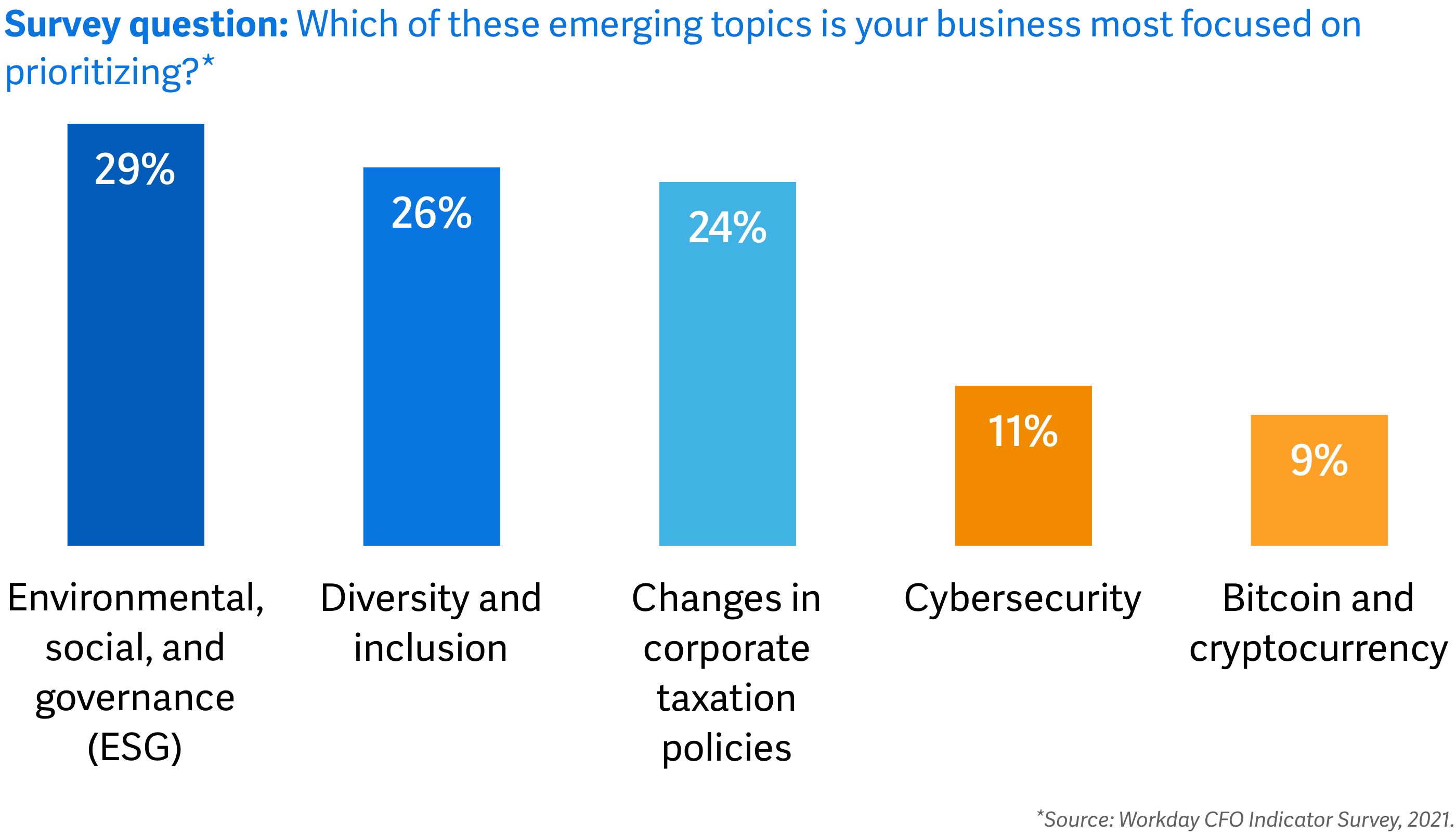
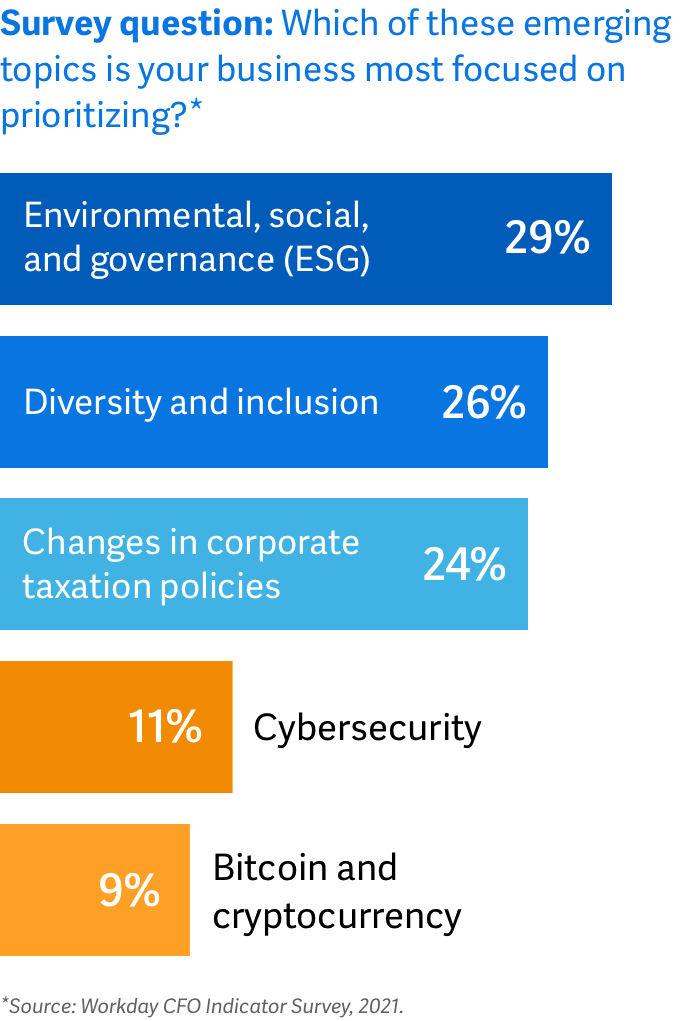
Emerging topics that are top of mind for CFOs
Cloud-based ERP is the Next Revolution
Legacy ERP systems of the past were more about managing physical things. The priority now is on managing the way value gets created today, with talent, data, intellectual property, and other intangibles.
Cloud has already transformed sales (CRM) and HR (HCM) systems. Now, it’s transforming finance and procurement. With that foundation, CFOs have the tools to take on a more significant governance role with data, and to make fast, informed decisions backed by data.
Intelligent financial management software is integral to supporting CFOs. Through an embrace of modern cloud solutions – and a mindset shift in how work is performed – the finance function can have seamless access to external, operational and financial data sets that deliver the insights needed to thrive in today’s fast-changing economy.
“Whether you’re trying to drive profitable growth or create a culture of cost containment, those are all powered by the insight that comes from combining financial data, operational data and people data. Getting insight that will drive a specific business requires the interplay of these three types of information.”
Karen dela Torre, Executive Director, Office of the CFO at Workday
.jpg)